J
EP. 002
AI for Solo Founders
WEDNESDAY, JULY 29, 2026
Two of the things in this issue took me about twenty minutes each to build.
That's the part I want you to notice.
None of this is a big project. It's a prompt, a small app, and a tool I stumbled into. Little stuff that either saves you an hour or puts your content in front of more people.
That's the whole game when you're running the thing on your own. You don't win by building one enormous system. You win by stacking a lot of small ones, right?
Here's the week.
Video Walkthrough
THIS WEEK IN AI
1
Why it matters: Last week I told you competition works in your favour. Here's the receipt. Opus 5 came within half a percent of Fable 5 on CursorBench at half the cost per task. It's the new default on Max and the strongest model on Pro, and it's got an effort setting so you can crank the thinking up when it matters and save tokens when it doesn't. If you've been rationing your usage all month, this is the week that gets easier.
ANTHROPIC · 3 MIN READ
2
Why it matters: They launched a small business program on the 21st. Free virtual training, in-person AI academies across the US, starter guides, and integrations with Shopify and Intuit. The webinars walk through real workflows in accounting, marketing, e-commerce and ops, with prompts you can run the same day. Yes, it's a push to get you onto ChatGPT Work. It's also free training built for exactly your situation, which means "I'm not technical enough" just stopped being a reason.
OPENAI · 2 MIN READ
Hot Take
Humanizer skills didn't fix AI slop. They just gave everybody the same human voice.
By default every Claude writes the same way. So everyone installed a humanizer skill, and now every Claude writes like a human. Still the same human, though.
The fix was never making it sound human. It's making it sound like you.
That means giving it real evidence of how you talk. Texts, emails, captions, video transcripts, whatever you've got. Then having it interview you about your patterns and turn all of it into a voice profile you can reuse forever.
One thing people get wrong when they strip out the AI patterns: don't strip out yours. Some people genuinely use em dashes. If that's you, you don't want them removed. You're after your fingerprints, not a clean room version of you.
Automation of the Week
SAVES hours of manual posting
The trial reels app I built in an afternoon
01
Make a few versions of the same video. I literally just changed the colour of the text hook. That's it.
02
Drop the files into the app, pick your Instagram account, name the test, and write one caption that gets applied to all of them.
03
Hit publish. They all go up as trial reels at once, which means they get shown to people who don't follow you yet.
04
Watch which one wins. My first test had a variant hit 11,000 views and pull 15 new followers. Not life changing. But it's 11,000 more than I'd have got sitting on it.
05
How I built it: I told Codex I wanted an app that posts trial reels. It gave me three designs, I plugged in Zernio for the posting API, and I had a working app. Zernio is free for your first two accounts.
TOOL OF THE WEEK

MagicPattern
Free tier, no card
A toolbox of 30+ generators for backgrounds, patterns and image effects. Mesh gradients, halftones, dither, noise, blobs, waves, god rays, 3D perspective grids.
You pick an effect, push a few sliders, and export it as a PNG, SVG or WebP. Or you grab the CSS and paste it straight into whatever you're building.
This is the thing that fixes the "my design looks like AI made it" problem without you having to learn design. One good texture or background does more for a landing page than another hour of prompting.
Verdict: bookmark it. You'll use it the next time something you built looks flat.
Try it →
PROMPT OF THE WEEK
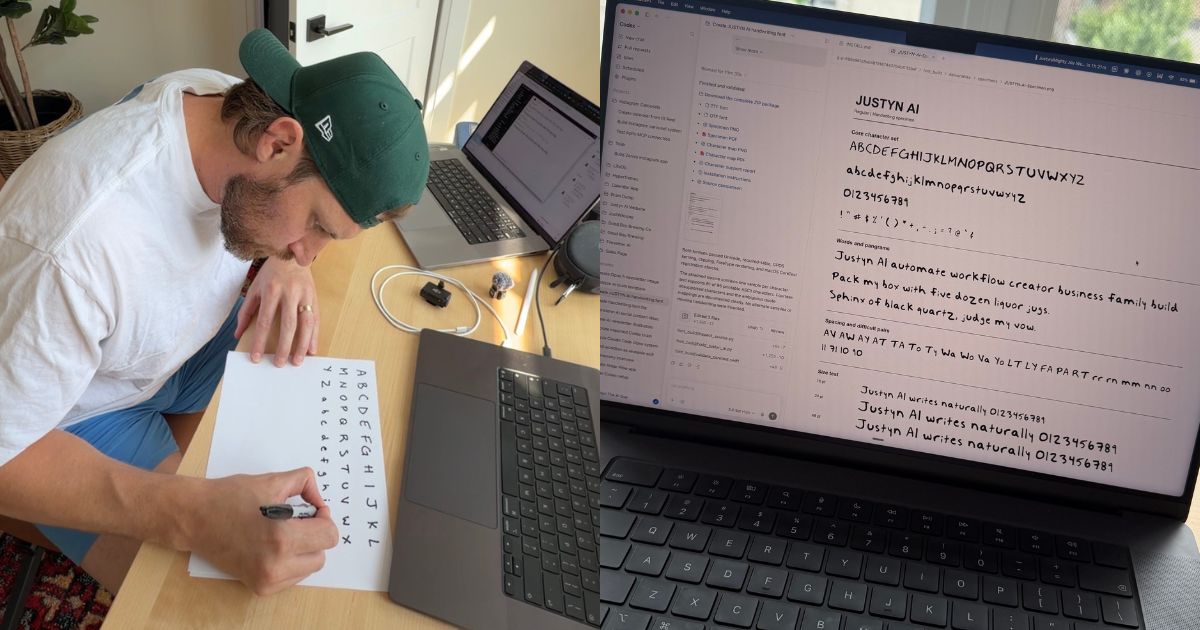
Turn your handwriting into a real font
Print a character sheet, write out every letter, number and symbol three times, and scan it at 600 DPI. A photo works too, and an iPad works noticeably better than a phone.
Hand the scan to ChatGPT with the prompt below. You get back TTF and OTF files, a specimen sheet in PNG and PDF, a full character map, a report of anything missing, and install instructions.
Three samples of each character is the part people skip. It's what keeps the natural irregularity in, instead of flattening you into another generic handwritten font.
I have attached a high-resolution 600 DPI scan of a handwriting template. It contains three clearly labeled samples of every uppercase letter, lowercase letter, number, punctuation mark, and symbol.
Create a production-quality black-and-white handwriting font from this source.
Font requirements:
See the full promptShow less
I have attached a high-resolution 600 DPI scan of a handwriting template. It contains three clearly labeled samples of every uppercase letter, lowercase letter, number, punctuation mark, and symbol.
Create a production-quality black-and-white handwriting font from this source.
Font requirements:
- Family name: [FONT NAME]
- Style: Regular
- Produce both TTF and OTF files.
- Preserve the personality and natural irregularity of my handwriting.
- Remove paper texture, shadows, guide lines, dust, stray marks, ink blobs, and scanning artifacts.
- Do not redesign the handwriting into a generic handwritten font.
- Use the strongest sample of each character as the primary glyph.
- If multiple clean samples are available, use the additional samples as OpenType stylistic or contextual alternates where practical.
- If a character is missing or ambiguous, identify it clearly. Do not invent a replacement without telling me.
Glyph construction:
- Convert every character into clean, scalable vector outlines.
- Smooth jagged contours and reduce unnecessary vector points.
- Preserve natural stroke variation while keeping the overall weight visually balanced.
- Clean rough endpoints and accidental overlaps.
- Keep counters open and readable at smaller sizes.
- Preserve natural character widths.
- Normalize cap height, x-height, baseline, ascenders, descenders, and punctuation placement.
- Apply optical overshoot to rounded characters where appropriate.
- Set optical side bearings for every glyph.
- Add useful kerning pairs, including uppercase pairs, uppercase-to-lowercase pairs, punctuation pairs, and number combinations.
Character coverage:
- Include all characters visibly provided in the template.
- Support the complete printable ASCII character set when source samples are available.
- Correctly map straight quotes, curly quotes, apostrophes, punctuation, currency symbols, mathematical symbols, brackets, braces, and slashes.
- Include a proper space character and sensible word spacing.
Quality assurance:
- Render uppercase, lowercase, numbers, punctuation, pangrams, common words, and difficult letter pairs.
- Test the font at 16, 24, 48, 96, and 144 points.
- Check for closed counters, distorted proportions, inconsistent baselines, clipping, excessive spacing, and missing glyphs.
- Validate the Unicode character map and required TTF and OTF font tables.
- Confirm that both files install and render correctly.
Deliver:
1. The finished TTF file.
2. The finished OTF file.
3. A specimen sheet in PNG and PDF formats.
4. A complete character-map sheet.
5. A report listing supported and missing characters.
6. Installation instructions.
7. A ZIP containing all deliverables.
Before finalizing, compare the rendered specimen against the source handwriting and correct any obvious extraction, spacing, proportion, or character-mapping problems.
COPY · PASTE · REPLACE THE BRACKETS
道
The Trialr build is free inside the Dojo
I gave everyone in the AI Dojo the whole thing. The exact code, the step by step install, all of it. Download it, drop it into Claude Code or Codex, make a Zernio account, and you've got your own trial reels app running for nothing.
I'm also partway through the Clone Yourself series in there, building the AI brain that writes this newsletter.
Your first hire is AI.
Join the Dojo
100+ FOUNDERS INSIDE
 by Justyn. Shipped with
  by AI.